FASCIA -
What’s the BIG deal?
Fascia sits at the intersection of structure and sensation, which is why it has become a frontier in modern movement and wellness. It is a single continuous 3-dimensional web of connective tissue that surrounds, interpenetrates, and connects every muscle, bone, nerve, blood vessel, and organ in the body.
One system. Everything connected.
It is one of the most innervated organs in the body (250 million sensory nerve endings) - a giant sensory screen that feels literally everything: pressure, stretch, temperature, vibration, pain. There are recognised myofascial lines, or meridians, that connect muscles through fascia. These lines explain how tension in one area can affect another.
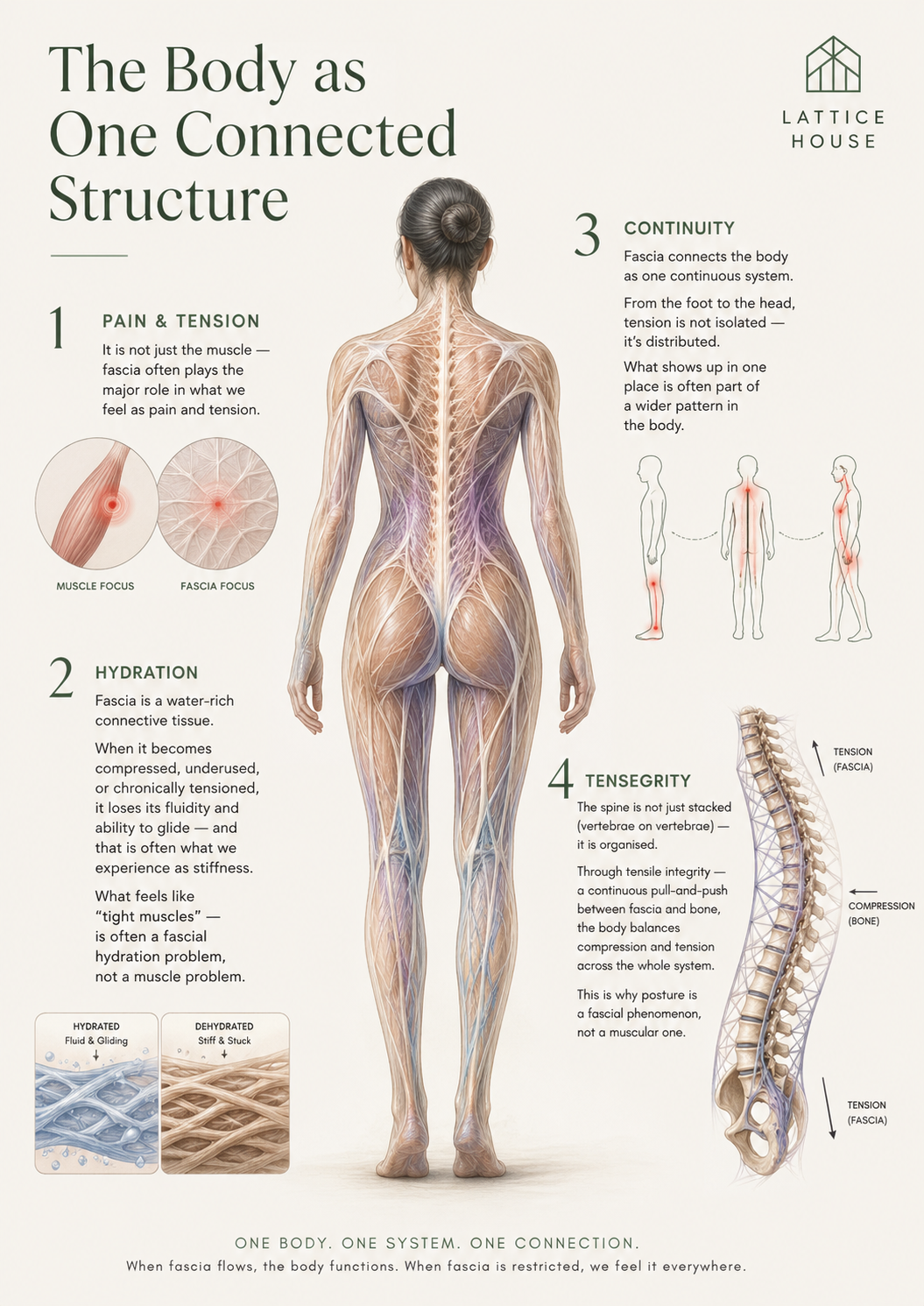
The Body as One Connected Structure
Pain & Tension: It is not just the muscle — fascia often plays the major role in what we feel as pain and tension.
Hydration: Fascia is a water-rich connective tissue. When it becomes compressed, underused, or chronically tensioned, it loses its fluidity and ability to glide — and that is often what we experience as stiffness. What feels like “tight muscles” — is often a fascial hydration problem, not a muscle problem.
Continuity: Fascia connects the body as one continuous system. From the foot to the head, tension is not isolated — it’s distributed. What shows up in one place is often part of a wider pattern in the body.
Tensegrity: The spine is not just stacked (vertebrae on vertebrae) — it is organised. Through tensile integrity — a continuous pull-and-push between fascia and bone, the body balances compression and tension across the whole system. This is why posture is a fascial phenomenon, not a muscular one.
The Sensory Pathway to Calm
Mechanosensitivity: Fascia is not just structure — it is sensation. Densely innervated with mechanoreceptors, it responds to pressure, stretch, and tension. Working directly with this fascial sensory network influences the nervous system state and supports a shift toward parasympathetic calm.
Autonomic Balance: Fascia release increases Heart Rate Variability by enhancing vagal control reducing sympathetic load, and helping the body move toward recovery and autonomic balance.
Proprioception & Interoception & Safety: Fascia contains sensory receptors, including Ruffini endings, that respond to slow stretch and sustained pressure.These sensors help the brain track where the body is and can support a softer, less guarded state when the input feels safe and sustained.